
Leeds Glass Suppliers. Call our team on
Get A Fast Quote
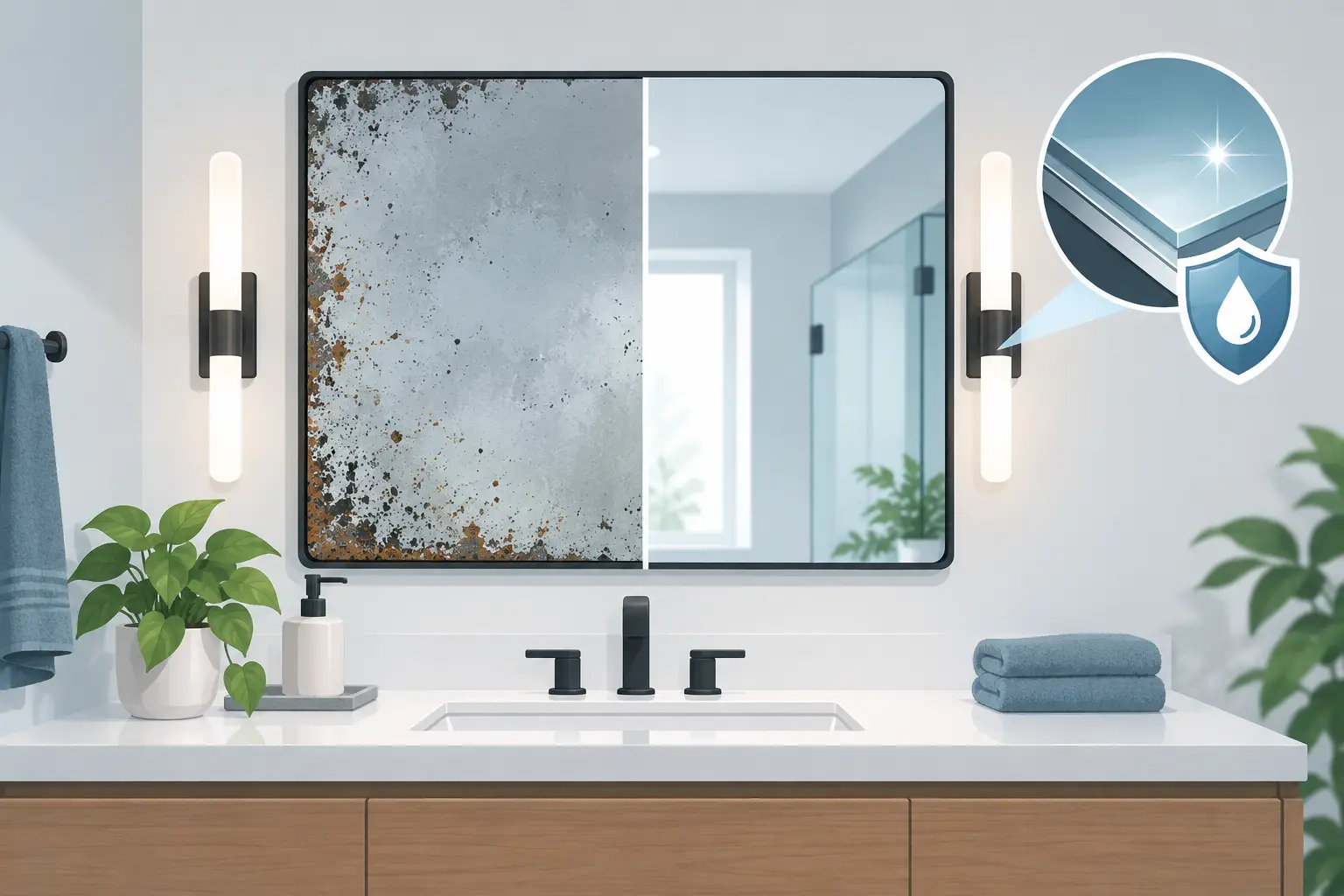
A mirror can look perfectly good from the front while the damage starts quietly at its edges. Black spots, dark patches and lifting around the perimeter are usually signs that moisture has reached the mirror backing. Knowing how to prevent mirror corrosion is particularly useful in Yorkshire bathrooms, where a cold room, steamy showers and limited ventilation can create the conditions it needs.
The good news is that corrosion is not inevitable. The right mirror specification, sensible fitting and a few everyday habits will make a real difference. It is also worth acting early: once the reflective backing has deteriorated, cleaning will not bring it back.
Most household mirrors are made by applying a reflective coating and protective paint to the back of the glass. If water vapour, condensation or cleaning liquid reaches that backing, it can begin to break it down. This is often called black edge, mirror desilvering or mirror rot, although the affected areas may appear brown, grey or black.
Bathrooms are the usual trouble spot because showers and baths put a large amount of warm moisture into the air. That moisture settles on cooler surfaces, including the face and edges of a mirror. A poorly ventilated en-suite, a shower room without an opening window, or a mirror positioned close to the basin can all increase the risk.
The edge is vulnerable because it exposes the layers behind the glass. Damage can also begin where the backing is scratched during handling or installation. Even a quality mirror can have a shortened lifespan if it is fixed tightly against a damp wall, sealed in with moisture behind it, or regularly sprayed with harsh cleaner.
The first decision is the mirror itself. A standard decorative mirror may be suitable for a dry bedroom or hallway, but a bathroom calls for a product designed to cope with humid conditions. Ask for a moisture-resistant mirror with suitable edge protection, especially if it will be near a shower, bath or basin.
For a busy family bathroom, a bespoke mirror is often a better long-term choice than adapting an off-the-shelf size. It can be made to sit clear of splash zones, fit neatly between tiles or furniture, and allow the correct fixing detail around the edges. This matters with full-width vanity mirrors, which can otherwise be difficult to remove or dry behind if water gets in.
There is a trade-off with very large mirrors and wall-to-wall designs. They create a clean, spacious look, but every edge needs careful consideration. Where the mirror meets a worktop, tiled upstand or shelf, make sure there is no route for standing water to sit against the backing.
If you are specifying a mirror for a rental property, hotel bathroom or commercial washroom, it is worth discussing expected use as well as size. High-traffic rooms need materials and fitting methods that can tolerate frequent cleaning and repeated steam exposure.
A well-made mirror still needs to be installed properly. In practice, poor installation is one of the most avoidable causes of early corrosion.
Leave a small air gap behind the mirror where the design allows. This encourages airflow and helps any moisture dry rather than becoming trapped against the backing. A mirror bonded directly to a cold external wall can be more susceptible to condensation, particularly in older homes. In those cases, suitable spacers and a sound, dry wall surface are helpful.
Use an adhesive specifically intended for mirrors. Some general-purpose grab adhesives and solvent-based products can attack the backing over time, leaving visible marks or causing the reflective layer to fail. Mechanical fixings are another option, and they can make removal easier in future, but the holes and exposed edges must be prepared carefully.
Avoid sealing every edge tightly to the wall unless the mirror manufacturer has specified that approach. It may seem like the best way to keep water out, but an unventilated seal can trap moisture behind the glass. Where sealant is needed around a basin splashback or in a wet area, use a neutral-cure product that is compatible with mirror backing and apply it only where appropriate.
A good installer will also check that the wall is dry before fitting. Fresh plaster, newly grouted tiles and recently painted surfaces can all hold moisture. Rushing to install a mirror during the final stages of a refurbishment may save a day or two, but it can introduce damp behind the glass from the outset.
A mirror above a basin is common and practical, but it should not be constantly soaked. Position it high enough to avoid regular splashing, particularly where children use the room. In a shower enclosure, choose a product and installation method intended for that location rather than treating an ordinary mirror as a shower-screen accessory.
For bathrooms with limited wall space, a recessed cabinet can be useful, provided it is designed for humid rooms and fitted correctly. The same principle applies: water should not be able to collect at the lower edge or behind the unit.
Ventilation is the most effective everyday defence against bathroom moisture. Run the extractor fan while showering and leave it on afterwards for long enough to clear the humid air. A fan with a humidity sensor can be particularly useful because it continues working when the room needs it, rather than relying on somebody remembering to use the switch.
Open a window when practical, but do not depend on this alone during colder weather. Many people keep windows shut in winter, exactly when the difference between warm bathroom air and cold glass makes condensation more likely. If the room stays wet for a long time after a shower, improve the extraction rather than accepting it as normal.
Wiping down the shower screen, tiles and mirror after use reduces the amount of water left to evaporate. It is a small job, but it helps in compact bathrooms where every surface steams up. Keep towels from drying directly over a radiator in a poorly ventilated room too, as they add moisture to the air for hours.
Heating also has a role. A consistently cold bathroom encourages condensation on glass. You do not need to overheat the room, but maintaining a reasonable temperature and ventilation routine will reduce damp surfaces.
It is easy to damage a mirror while trying to keep it spotless. The main rule is simple: spray cleaner onto a soft cloth, not directly onto the mirror. When liquid is sprayed onto the glass, it can run down and gather along the bottom edge, where it may work its way into the backing.
Use a clean microfibre cloth, lightly dampened with water or a mild glass cleaner. Wipe gently and dry the edges afterwards. Avoid abrasive pads, scouring powders and strong acidic or alkaline cleaners. These can scratch the glass, affect decorative finishes and potentially compromise vulnerable edges.
Take extra care with framed mirrors. Water can sit between a frame and the glass, particularly at the bottom corners, so do not soak the frame when cleaning. If you notice persistent moisture, discolouration or a musty smell behind the mirror, investigate the source rather than repeatedly cleaning the visible surface.
Mirror corrosion normally starts at the edge, often as tiny dark pinpoints. Check the lower corners and the area nearest taps, showers or window reveals every few months. Early signs do not always mean the mirror will fail immediately, but they do suggest moisture is reaching a place it should not.
Look for peeling backing, dark rings around fixing holes, cloudy patches that do not wipe away, or water staining on the wall below. Also check silicone joints around nearby sanitaryware. A failed seal around a basin or tiled splashback can direct water behind a mirror without being obvious from the front.
Once the reflective coating has corroded, repair is rarely worthwhile. The practical answer is usually replacement, combined with correcting the ventilation, positioning or fitting issue that caused the damage. Replacing the mirror alone without addressing the cause can lead to the same problem again.
A simple rectangular mirror in a well-ventilated bathroom is usually straightforward. More complex spaces benefit from advice before anything is made. This includes mirrors fitted into alcoves, panels meeting tiled walls, coloured or antique mirror features, mirrored cabinet doors, and large pieces installed over vanity units.
At Yorkshire Glass, made-to-measure mirrors can be discussed around the realities of the room, not just the dimensions on a plan. That means considering ventilation, nearby water sources, edge finishes, fixing methods and the condition of the wall before the mirror is cut.
A bathroom mirror should add light and usefulness for years, not become another maintenance issue. Give moisture somewhere to go, keep cleaning liquid away from the edges and make sure the mirror is fitted for the environment it will live in. Those practical details are what protect the finish long after the renovation is complete.