
Leeds Glass Suppliers. Call our team on
Get A Fast Quote
A shower screen that looks excellent in a showroom can feel completely wrong once it is fitted around an uneven wall, a sloping ceiling or a compact bath. Choosing the best glass for bathrooms is not simply a matter of clear versus frosted. It means matching the glass to the room, the level of privacy you need and the way the space will be used every day.
For most bathroom projects, safety glass is the starting point. From there, the best choice depends on whether you are planning a frameless shower enclosure, a bath screen, a mirror wall, a privacy partition or coloured glass wall panels. Getting those details right before ordering avoids costly changes later.
Bathrooms are high-use spaces with hard surfaces, water and restricted room around baths and showers. Glass used in and around a shower should normally be toughened safety glass, made to break into small, less hazardous pieces if it is damaged. It is considerably stronger than ordinary annealed glass and is the standard choice for shower screens, shower doors and many bathroom partitions.
Toughened glass must be cut, drilled and shaped before it is toughened. That is why accurate measuring matters so much. Once the glass has been processed, it cannot be trimmed down to accommodate a wall that is out of plumb or a fitting that has moved.
For frameless shower screens, glass is commonly specified at 8mm or 10mm thick. An 8mm panel is a strong, practical option for many fixed screens and smaller enclosures. At 10mm, the glass has a more substantial feel and can suit larger panels, hinged doors and minimal-framing designs. The right thickness also depends on the panel dimensions, fixing method and hardware being used, so it should be considered as part of the complete installation rather than in isolation.
Laminated glass may be appropriate for certain specialist applications, particularly where an extra layer of retention is required. However, it is not automatically the right upgrade for every shower. The exposed edges and construction need careful consideration in a damp setting. A proper specification should always account for where the glass sits, how it is supported and the requirements of the fittings.
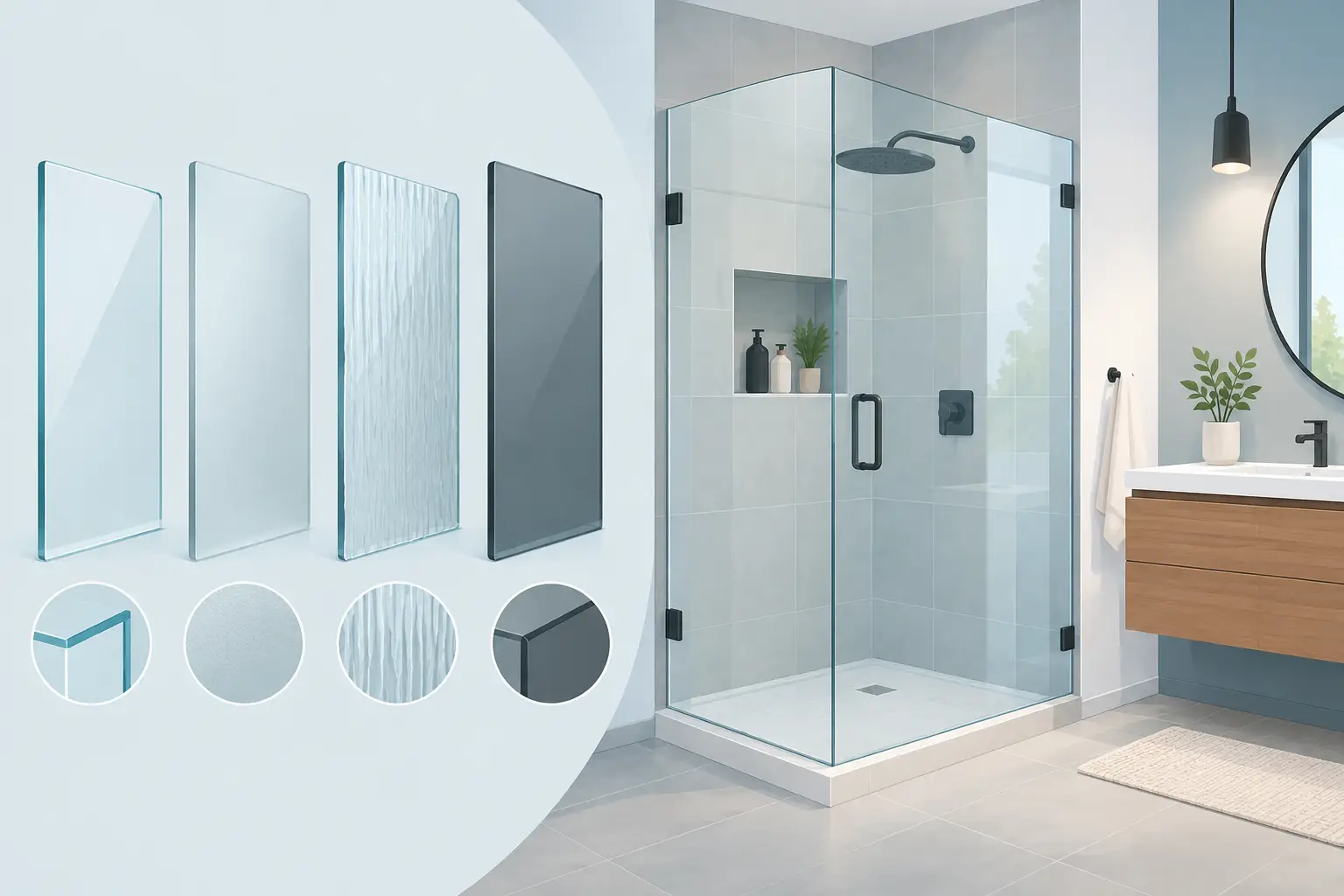
Clear toughened glass remains popular because it makes a bathroom feel more open. It is especially effective in smaller rooms, where a heavy framed enclosure or opaque screen can break up the sightlines. Clear glass also lets decorative tiles, stone or brassware do the visual work.
Standard clear glass has a natural green tint, most noticeable along polished edges and against white or very pale backgrounds. In a bathroom with crisp white tiles, light marble-effect surfaces or a carefully chosen colour scheme, low-iron glass can be worth considering. It has reduced green tint and gives a cleaner, truer appearance. The difference can be subtle in some settings, but clear in a bright, minimal bathroom or on a large frameless screen.
Privacy is the main reason to choose an obscured finish. Frosted or acid-etched glass diffuses light while reducing visibility, making it useful for shower screens in shared bathrooms, WC partitions or internal windows. Patterned glass can introduce character without making the room feel enclosed. Reeded glass, for example, softens the view through it while still allowing light to travel across the room.
Think about which side of the glass will be most exposed to water and cleaning. Some decorative finishes need to be positioned or protected carefully to keep them looking their best. This is one area where viewing a physical sample is far more useful than relying on a photograph.
A fixed walk-in shower screen is often the simplest way to create a clean, contemporary bathing area. It needs fewer moving parts than a door and works well in rooms where there is enough floor space for water to remain within the showering zone. A wider screen offers more splash protection, but it also affects access, so the layout needs to be balanced carefully.
For a shower over a bath, a hinged or fixed bath screen can give a lighter look than a curtain and is straightforward to clean. The glass still needs to be toughened, with suitable hinges, seals and wall channels designed for the panel size. A screen that is beautifully made but poorly fitted will not keep water where it should be.
Fully frameless enclosures offer minimal lines and a high-end finish, but they place more emphasis on accurate survey work. Bathroom walls are rarely perfectly straight. Tiles can vary in depth, floors can fall for drainage and ceiling lines may not be level. Made-to-measure glass allows for these realities, rather than forcing a standard panel into an awkward gap.
Framed or semi-framed systems can be the better practical choice where walls are uneven or where you want more adjustment during fitting. They also suit many family bathrooms well. Frameless is not always better - it is simply a different look with different fitting tolerances and costs.
A well-placed mirror can change a bathroom as much as a new shower screen. It reflects light, makes a narrow room feel wider and gives a vanity area a more considered finish. But bathroom mirrors need attention to size, fixing and position.
A mirror above a basin should be proportionate to the furniture beneath it and leave enough room for lighting, taps and splashback areas. A large wall mirror can be particularly effective in an ensuite or cloakroom, while shaped mirrors soften the straight lines of tiled walls and fitted units.
In humid rooms, choose a mirror made and finished for the environment. The edges, backing and installation method all matter. Leaving the correct clearance from wet surfaces and avoiding standing water around the bottom edge helps protect the mirror over time. If you are adding lighting, demister pads or sockets nearby, plan this before the mirror is measured and manufactured.
Antique-effect and coloured mirrors can bring warmth and depth to a bathroom, especially where a plain silver mirror would feel too stark. They are often best used as a feature rather than across every wall. A sample helps you see how the finish responds to your tiles, lighting and the changing daylight in the room.
Tiles are not the only option around a basin, vanity unit or bath. Back-painted toughened glass panels create a smooth, easy-clean surface with no grout lines. They can be colour-matched to cabinetry or selected as a contrast to neutral sanitaryware.
Glass wall panels work particularly well behind a basin where repeated splashes can mark painted walls. They can also be used as a full-height feature behind a freestanding bath, provided the surrounding installation is designed properly. A gloss finish reflects light, while a more understated colour can add depth without making the room feel busy.
As with shower glass, every socket cut-out, tap hole and shaped edge needs to be agreed before manufacture. A bespoke panel should follow the actual dimensions of the wall, not just the nominal size shown on a plan.
The glass is only one part of the finished result. Hinges, handles, channels, brackets and seals should complement the bathroom fittings and be suitable for a wet environment. Polished chrome remains a classic choice, while brushed brass, matt black and brushed nickel can tie a screen or mirror into the wider scheme.
Polished edges are usually the natural choice where glass edges remain visible. They feel smooth to the touch and give clear or low-iron glass a refined finish. In some designs, concealed channels or framing may hide the edge, but this should be decided early as it affects the final dimensions.
No glass is entirely maintenance-free. Water spotting is more noticeable in hard-water areas, particularly on clear frameless screens. A protective coating can reduce the effort required, but it does not remove the need for regular cleaning. A quick wipe with a shower squeegee after use and a non-abrasive cleaner will keep glass clearer for longer. Avoid harsh scouring pads that can damage coatings, seals and metal finishes.
The best time to finalise shower glass is after tiles, shower trays, wall finishes and key fittings are in place. Measuring too early is a common source of problems, especially when tile thickness or waterproofing details change the finished opening.
For unusual layouts, a site measure is worth arranging. Angled ceilings, half walls, notched panels, walk-in showers and oversized mirrors all benefit from a proper assessment of the finished room. Yorkshire Glass manufactures made-to-measure products in Leeds, so the glass can be specified around the space you actually have rather than adapted from standard stock.
Bring a photograph, a rough sketch or a tile sample when discussing your plans. The right choice is usually clear once you can compare the finishes, talk through the fixing points and see how the glass will work in your own bathroom.