
Leeds Glass Suppliers. Call our team on
Get A Fast Quote
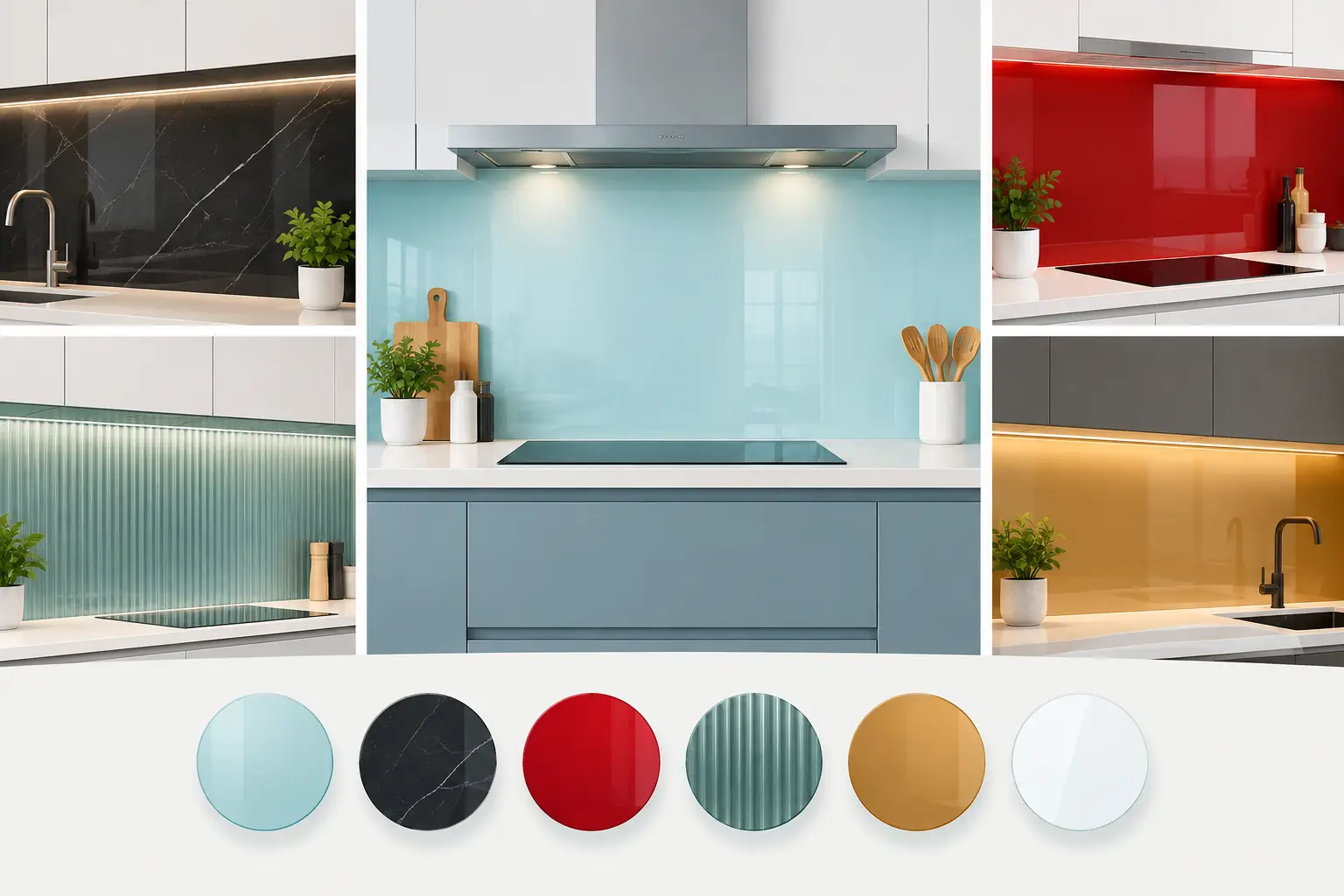
A kitchen splashback has a demanding job. It needs to protect the wall behind the hob and worktop from cooking splashes, stand up to regular cleaning and look right alongside your cabinets, worktops and lighting. The different types of glass splashbacks for kitchens give you far more scope than standard tiles, particularly when the panel is made to fit the space precisely.
Glass has a clean, joint-free surface that is easy to wipe down, but the finish you choose makes a significant difference to the final look. From a calm painted colour to a reflective mirror or a statement printed design, the best option depends on how you use the kitchen and what you want the room to feel like.
Painted glass is the most popular choice for many kitchens because it offers almost unlimited colour possibilities. The colour is applied to the back of the glass, so the front remains smooth, glossy and protected from everyday cleaning. It creates a rich, even finish that can be matched to cabinetry, picked from a favourite paint shade or chosen to contrast with a neutral scheme.
A pale grey, soft white or warm neutral glass splashback can make a compact kitchen feel open without the maintenance of white grout. At the other end of the scale, deep navy, forest green or charcoal can give a simple run of units more character. Strong colours tend to work particularly well in kitchens with plain doors and uncluttered worktops.
The key practical point is to view a sample before committing. Colour can look different against a white wall, dark worktop or under warm LED lighting. For a made-to-measure panel, it is worth taking the time to check the shade in the room where it will be installed.
For light colours, ask about low-iron glass. Standard clear glass has a slight green tint, most noticeable around polished edges and behind pale whites, creams and greys. Low-iron glass reduces that tint, helping the chosen colour appear cleaner and more accurate.
It is not always necessary. Dark, saturated colours usually look excellent on standard toughened glass, so the decision often comes down to the colour, budget and the level of finish you want.
Printed glass splashbacks are for homeowners who want the splashback to become a design feature rather than a quiet backdrop. A high-quality image, pattern or graphic is printed behind the glass, where it is protected from heat, moisture and cleaning products.
This could be a subtle marble effect that complements a worktop, a detailed botanical design, a cityscape or an abstract wash of colour. A printed panel can also reproduce the appearance of materials that would be less practical behind a hob, such as wallpaper or natural stone with pronounced texture.
The trade-off is longevity of taste. A large image can be striking, but kitchen cabinetry may remain in place for many years. If you like changing accessories and wall colours regularly, a quieter printed texture is often easier to live with than a bold scene. Image quality matters too: a low-resolution photograph can look disappointing once enlarged, so the artwork should always be checked before manufacture.
Clear glass is a practical solution where you want to protect an existing surface without hiding it. It is commonly fitted over wallpaper, painted plaster, brick slips, decorative tiles or a feature wall. The glass acts as a tough, wipe-clean shield while allowing the material beneath to remain visible.
This option works well away from the hob, behind a sink or along a worktop run where the background is already part of the design. It can also be useful if you have found a wallpaper you love but are concerned about moisture and cooking marks.
There are a few considerations. Any wall finish behind clear glass needs to be fully cured, clean and consistently applied before fitting. Marks, uneven paint and trapped dust will show through. Clear glass also reflects some light, which is usually attractive, but it will not disguise an imperfect background in the way an opaque painted panel will.
A mirrored glass splashback brings depth and light to a kitchen, making it an especially effective choice in narrower rooms or spaces with limited natural daylight. It reflects the worktop, pendant lights and opposite wall, giving the kitchen a more open feel without changing its footprint.
For an industrial, period or darker kitchen scheme, antique mirror glass offers a softer, more characterful alternative to a standard silver mirror. Its aged pattern and tonal variation work beautifully with timber, brass, black fittings and painted shaker-style units. It is decorative by nature, so each panel has its own visual movement.
Mirror needs thoughtful positioning. It will reflect whatever sits opposite it, including open shelving, appliances and day-to-day kitchen clutter. It can also show steam marks more readily than a mid-tone painted glass, although a quick wipe with a suitable glass cleaner keeps it looking smart. If the splashback will sit behind a gas hob, make sure the specification is suitable for the heat involved.
Textured glass is a less common but useful option when you want softness, privacy or a little visual interest without a printed image. Depending on the glass selected, it can diffuse reflections and add a tactile quality that suits traditional kitchens, utility rooms or bar areas.
Not every textured glass is appropriate close to a hob. A kitchen splashback needs to be easy to clean, and deeper textures can hold grease or make wiping more awkward. In most cooking zones, a smooth-faced panel is the more sensible choice. Textured glass tends to be best used in lower-splash areas or as part of a wider interior glass feature.
Metallic, pearlescent and glitter finishes offer another route for homeowners who want something more individual. These finishes can shift subtly in different light and work particularly well in contemporary kitchens with handleless units, polished worktops or feature lighting.
A metallic finish does not have to mean high shine. Brushed-effect silvers, warm bronzes and muted champagne tones can bring warmth without overwhelming the room. As with any distinctive finish, ask to see a physical sample beside the cabinet door and worktop. Small differences in undertone can make a big difference once the panel covers a long wall.
The finish is only one part of the decision. Where the splashback is going determines the glass specification. Behind a hob, toughened safety glass is normally required because it is made to withstand higher temperatures and, if broken, is designed to fragment into small pieces rather than dangerous shards.
Accurate measuring also matters more than people expect. Socket cut-outs, extractor positions, uneven walls and the gap between worktop and wall units all need to be allowed for before the glass is manufactured. Toughened glass cannot be cut or altered after processing, so measurements and drawings need to be checked carefully at the outset.
For a long run with several sockets, it is usually better to use fewer larger panels where practical, rather than creating lots of joins. This gives the clean, uninterrupted look people choose glass for in the first place. However, access can affect what is possible: a very large panel may be difficult to carry through a tight hallway or up a narrow staircase.
Start with the fixed elements of the kitchen: cabinet colour, worktop, flooring and handles. If these are already busy, a painted glass splashback in a complementary shade may give the room balance. If the kitchen is simple and neutral, mirror, print or a special finish can provide the point of interest.
Then think honestly about upkeep. All smooth glass splashbacks are straightforward to clean, but mirror and very dark colours show fingerprints and water marks more readily than mid-tone colours or patterned finishes. A busy family kitchen may suit a forgiving finish, while a carefully styled kitchen with good lighting may benefit from the drama of mirror.
At Yorkshire Glass, panels can be made in-house in Leeds to suit individual sizes, colours, cut-outs and layouts. Bringing cabinet and worktop samples into the showroom is often the quickest way to move from a broad idea to a choice that feels right in your own kitchen.
The best splashback is not necessarily the boldest one. It is the one that fits precisely, copes with the way you cook and still makes you pleased to walk into the kitchen years from now.