
Leeds Glass Suppliers. Call our team on
Get A Fast Quote
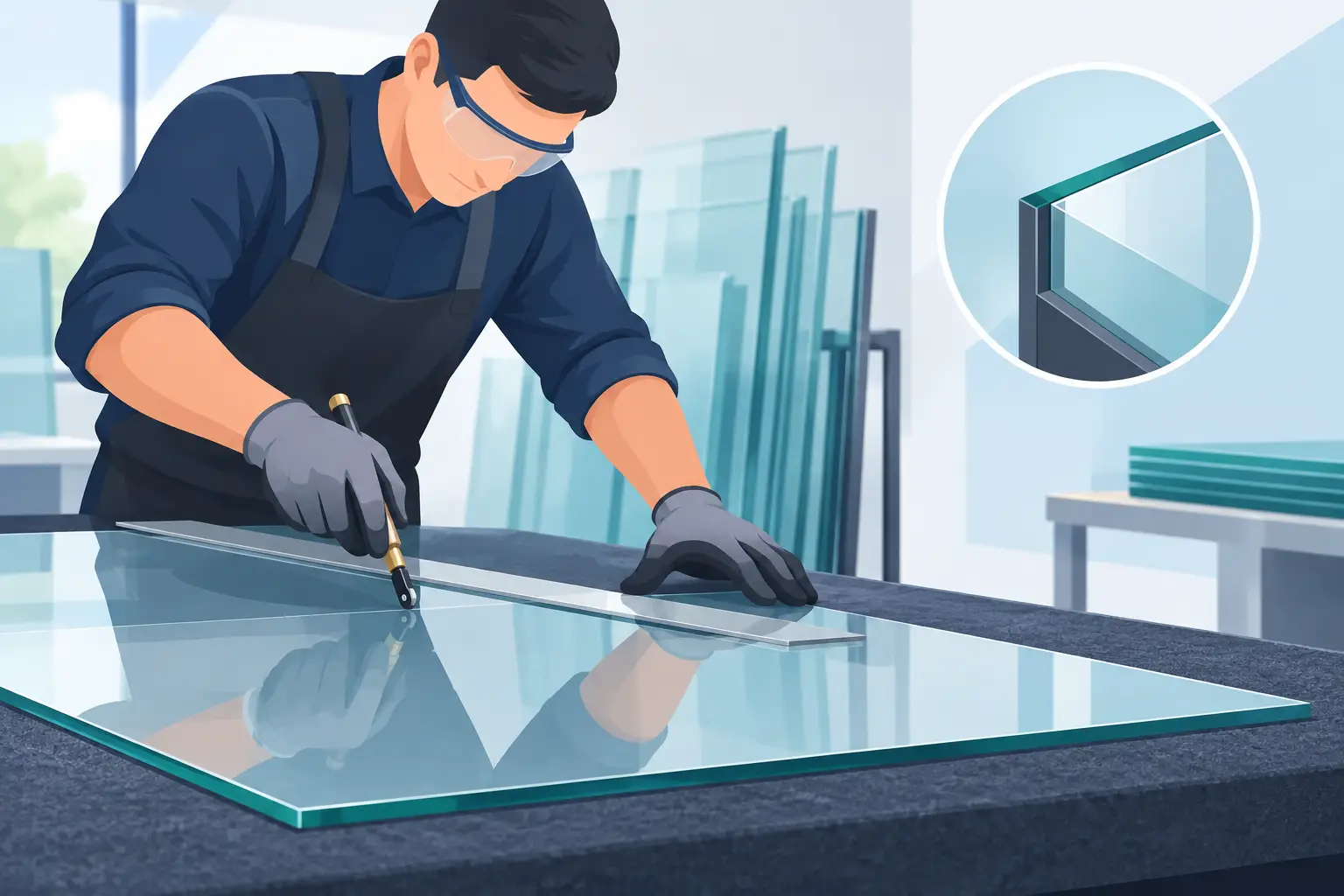
A glass cutting service is not simply about reducing a sheet to size. For a kitchen splashback that must sit around sockets, a replacement table top with softened corners, or a shower screen that meets a wall neatly, the detail in the measuring, processing and finish determines whether the result looks right and performs safely.
For homeowners, that means glass made for the space rather than a near-enough standard size. For trade customers, it means clear specifications, dependable lead times and a fabricator who can flag up practical issues before glass reaches site. At Yorkshire Glass, each order is considered around the application, the measurements and the finish required - not just the dimensions written on a form.
Custom-cut glass is useful wherever an off-the-shelf product would leave an awkward gap, overhang an edge or compromise the look of a room. Common requests include glass shelves, desk and table tops, protective glass for furniture, cabinet inserts, mirrors, coloured splashbacks and replacement panes for double glazed units.
It is particularly worthwhile in older homes, where walls and alcoves are rarely perfectly square, and in renovation projects where other materials have already been fitted. A made-to-measure piece can follow an unusual recess, allow for a chimney breast, work around sockets or accommodate a carefully chosen fitting position.
The right specification depends on where the glass will be used. A clear glass top for a side table has different requirements from a bathroom shelf, a balustrade panel or a kitchen splashback behind a hob. Thickness, edge finish, safety treatment, colour and fixing method all need to work together. Choosing the cheapest glass without considering these details can create unnecessary risks or leave a finish that does not last.
Most projects begin with a basic question: what sort of glass is needed? Standard clear glass can suit low-risk decorative uses, while toughened safety glass is often required where people may fall against it, where heat is involved or where building regulations apply. Toughened glass is stronger than ordinary annealed glass and, if it breaks, is designed to fragment into small pieces rather than dangerous sharp shards.
There is one crucial point to understand: toughened glass cannot be cut, drilled or shaped after it has been toughened. Every hole, notch, socket cut-out, polished edge and shaped corner must be processed before the toughening stage. This is why accurate information at quotation and measuring stage matters so much.
Laminated safety glass may be suitable for certain overhead, security or balustrade applications. It consists of glass layers bonded with an interlayer that helps hold the panel together if it breaks. For mirrors, the choice may be clear, tinted, antique or coloured, with the edge and backing selected to suit the room. A specialist can advise on the best option rather than assuming one product suits every job.
A cut edge is not always a finished edge. Glass used where an edge is visible or likely to be touched normally benefits from polishing, giving it a smooth, refined appearance. Arrissed edges can remove sharpness where a full polished finish is not needed. This choice affects both appearance and cost, so it is worth discussing before production begins.
Corners can be square, eased, rounded or shaped to suit the furniture or layout. Holes may be needed for handles, fixings or cable access. A kitchen splashback may require accurate cut-outs for plug sockets and switches. These features are entirely achievable, but they need clear dimensions and positioning from a fixed reference point. A vague measurement such as “roughly central” is not enough once glass is being prepared.
The most common cause of a poor fit is measuring an opening once and assuming it is uniform. Measure the width and height in more than one place, especially for alcoves, recesses and spaces between walls. Take the smallest dimension where the glass must fit within an opening, then allow a sensible fitting tolerance. Glass should not be forced tightly between uneven walls or hard surfaces.
For a glass top that sits on furniture, check the overall length and width, whether an overhang is wanted, and the exact location of any supports. For shelves, establish the finished shelf size as well as the type, number and position of brackets. For splashbacks, record every socket, switch, extractor and edge return before the template is approved.
Photographs are often helpful alongside measurements, particularly where a project involves a shaped area or existing fixtures. If there is any uncertainty, a site measure is the safer route. It can prevent delays caused by walls that bow, floors that rise or fittings that sit slightly out of line. This is not over-caution - glass is made accurately to the agreed specification, so there is very little scope to alter it later.
When providing positions for holes or cut-outs, choose one fixed corner as the datum point and measure every feature from that corner. Give the width and height of the cut-out, its distance from the chosen edges, and confirm whether the measurement is to the edge or centre of a hole. This approach avoids confusion and makes drawings much easier to check.
Where possible, do not take final dimensions until cabinets, worktops, tiles and electrical fittings are in their finished positions. A few millimetres can matter around sockets, wall units and tight openings.
Clear glass is a practical choice when the aim is to protect a surface while keeping the material below visible. It works well over timber, stone and painted furniture, but its green-tinted edge can be noticeable on thicker pieces. Low-iron glass offers a clearer edge and is often preferred where a bright white background or pale colour scheme is important.
For kitchens, painted glass splashbacks bring colour and an easy-clean surface to the wall behind a worktop or hob. The finish should be chosen with the room’s lighting in mind, as colours can look different beside warm timber, cool worktops and natural daylight. Viewing samples in person is useful when colour matching is a priority.
Mirrors do more than make a room feel larger. A precisely sized mirror can balance a vanity area, brighten a dark hallway or create a clean finish above a fireplace. Antique and tinted mirrors introduce more character, although their patterning and reflectivity are deliberately less uniform than standard silver mirror. That is part of their appeal, but it should be expected before ordering.
A local workshop offers practical advantages when a job has unusual dimensions, a tight programme or several elements that need to match. Questions can be answered by people familiar with the fabrication process, and changes are easier to discuss before production starts. For trade customers, this can be especially valuable when site conditions develop during a build.
Yorkshire Glass manufactures in Leeds, allowing the team to keep control of quality, specification and turnaround from the initial quote through to collection, delivery or installation support. There is also value in being able to visit a showroom, handle samples and speak to someone about what will work in the real space rather than choosing from a screen alone.
That does not mean every project needs the same level of service. A straightforward rectangular shelf with confirmed dimensions may be ready to order quickly. A large shower screen, coloured splashback or glass balustrade needs more discussion, because safety, fixings, tolerances and installation all matter. The appropriate route depends on the job.
A quote can be prepared more accurately when it includes the glass type, thickness, finished width and height, and whether the piece needs polished edges, holes, notches, shaping or corner work. Mention the intended use, particularly if the glass will be near a hob, in a bathroom, overhead or forming part of a barrier. A sketch and a few photographs can be enough to clarify a non-standard request.
If you are replacing existing glass, do not assume the original specification was correct for the application. Older installations may not meet current expectations for safety glass, and a replacement is a good opportunity to check what is appropriate now.
A well-planned glass piece should feel as though it has always belonged in the room: aligned with its surroundings, comfortable to use and properly finished at every visible edge. Bring measurements, ideas or even a rough sketch to the team, and the practical details can be resolved before your glass is made.