
Leeds Glass Suppliers. Call our team on
Get A Fast Quote
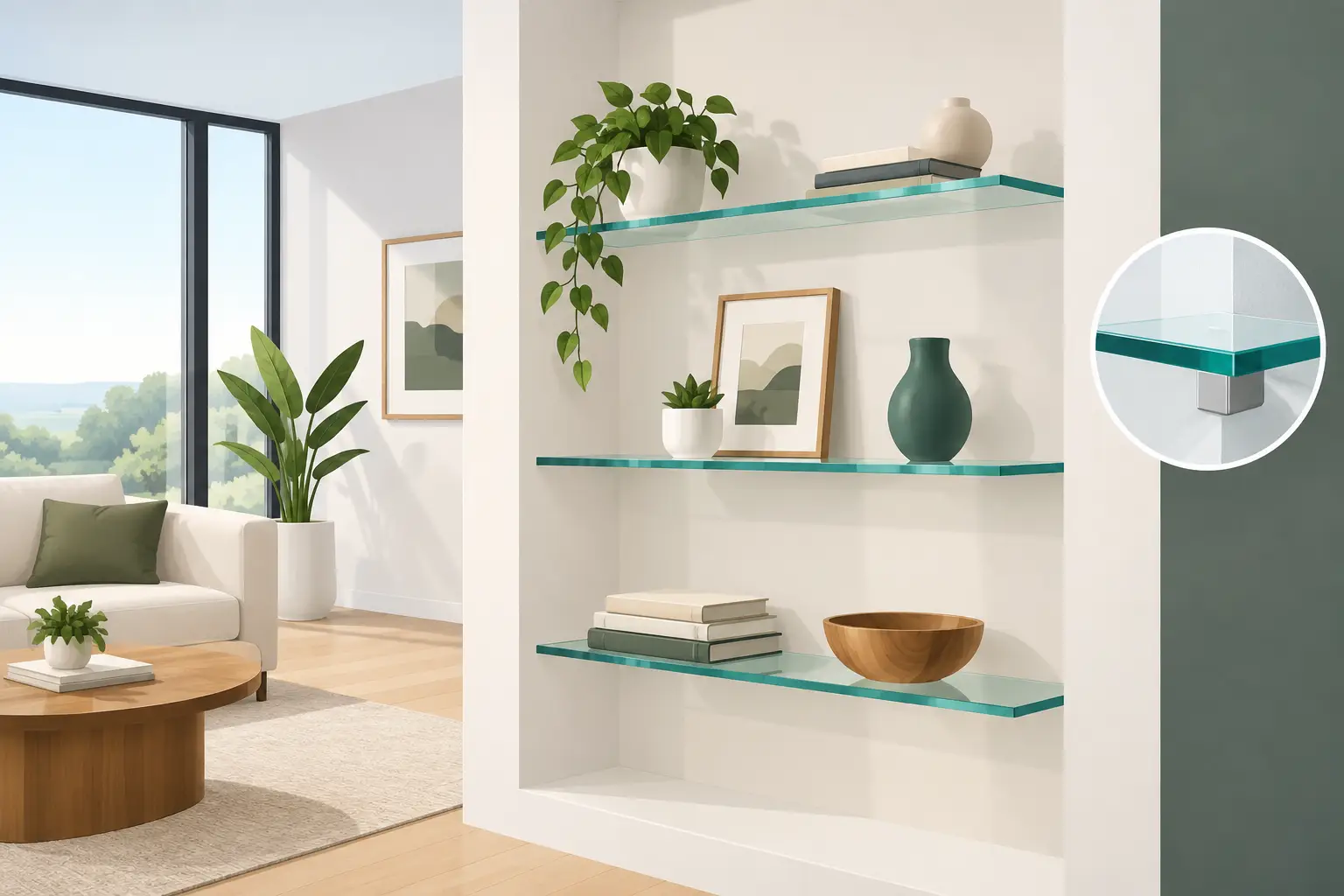
An alcove that is 8mm out of square, a bathroom recess beside a shower, or a display unit with an awkward centre support can make standard shelving a frustrating compromise. Custom glass shelves are made for exactly these situations. They give you a clean, light-reflecting surface that fits the space properly, rather than leaving gaps, overhangs or the need for improvised packing.
Glass shelving can be understated or become a feature in its own right. In a small bathroom it keeps the room feeling open. In a kitchen it offers a practical place for everyday items without adding visual weight. In a living room, fitted glass can bring light into a dark alcove and let the materials around it - timber, stone, painted joinery or wallpaper - do the talking.
The best result comes from getting a few practical decisions right before the glass is cut: where the shelf will sit, what it needs to hold, how it will be supported, and which finish suits the room.
Made-to-measure glass is particularly useful where a ready-made shelf will not do the job. Recesses and alcoves are rarely perfectly uniform, especially in older Yorkshire properties. A shelf can be cut to the exact width and depth required, with shaped corners or cut-outs where pipework, brackets or cables need to pass through.
Bathrooms are a popular choice. A clear shelf inside a tiled recess can hold toiletries without making the area feel crowded, while a shelf beneath a mirror creates useful everyday storage. Glass is easy to wipe down and does not swell or delaminate in the way some timber-based shelf materials can when exposed to moisture.
In kitchens, glass shelves work well in open shelving arrangements, display cabinets and around splashback areas. They can also be used to finish a purpose-built drinks area or to provide a discreet shelf within a glazed unit. For bedrooms and dressing areas, glass shelves are often chosen for fitted wardrobes, vanity spaces and display niches, where they keep the joinery looking neat and uncluttered.
Commercial settings benefit too. Retail displays, reception areas, salons and hospitality spaces often need shelves in non-standard sizes, with dependable edge finishing and accurate repeat measurements. For trade customers, having the glass produced to an agreed specification can make installation more straightforward on site.
A shelf should look refined, but it also has to carry its intended load safely. This is why the glass specification matters more than simply choosing a thickness by eye.
For most shelving projects, toughened safety glass is the sensible option. It is heat treated to be stronger than ordinary glass and, if it breaks, is designed to fragment into small pieces rather than large sharp shards. Toughened glass is particularly appropriate for bathrooms, family homes, public-facing interiors and shelves carrying regular use.
The right thickness depends on the shelf span, depth, glass type, support positions and what will be placed on it. A short shelf with continuous support beneath it has very different requirements from a long floating shelf supported only at each end. Books, bottles, kitchen equipment and heavy decorative objects all add up quickly.
There is no single thickness that suits every installation. A thicker shelf may be needed for a longer span or a heavier load, but thickness alone cannot solve poor support. Brackets, shelf clips, channels and concealed fixings all have their own weight limits and fixing requirements. The wall behind them needs consideration too. Solid masonry, studwork, tiled walls and fitted furniture require different approaches.
A good rule is to describe how the shelf will be used rather than guessing. Tell your glass supplier the width, depth, likely load, support method and room location. That gives them the information needed to advise on a suitable specification.
The edge is one of the first things people notice on a glass shelf. A polished edge has a smooth, clear appearance and removes the sharpness of a cut edge. It is usually the right choice where the edge will be visible or touched, which is most domestic shelving.
Corners can be left square, gently radiused or shaped to suit the setting. Rounded corners are often a practical choice in busy bathrooms or homes with young children. A notch can accommodate an upright, while a shaped rear edge may allow a shelf to sit neatly around pipework. These are small changes, but they can turn a difficult fitting job into a precise one.
Clear glass remains the most versatile option, though it is not the only one. Low-iron glass has less of the natural green tint visible in standard glass and can give a brighter appearance, especially on thicker shelves or against pale backgrounds. Smoked, tinted or coloured glass can create a more decorative effect, while antique mirror shelves can add character to a dressing room, bar area or period-inspired interior.
Consider the fittings as part of the overall design, rather than an afterthought. Chrome, brushed brass, black and stainless-steel finishes can either blend with taps, handles and shower hardware or provide a deliberate contrast. Concealed channels give a minimal look, but visible brackets may be the better option for a heavy shelf or an installation where future adjustment is useful.
Precision begins with measuring the actual opening, not the dimensions shown on a drawing or assumed from similar shelves elsewhere in the room. Walls can taper, tiles can vary in thickness, and fitted units may not be perfectly square.
Measure the width in at least three places - at the front, middle and rear of the opening - then work from the smallest measurement unless the shelf is being templated to follow an irregular shape. Take the depth at both sides too. If a shelf needs to fit between tiled walls, allow an appropriate clearance so it can be installed without forcing the glass into place.
For a simple rectangular shelf, a clear sketch with width, depth, thickness and any visible edge requirements is usually enough to start a quotation. For more complicated work, include the position and size of cut-outs, notches or holes, along with photos of the location. It helps to indicate which side is the front and where the shelf supports will sit.
Holes, cut-outs and shaped corners should be agreed before toughening. Once glass has been toughened, it cannot be cut, drilled or altered. This is a crucial point for shelves with cable holes, bracket fixings or unusual wall details. A final check before manufacture saves delays and prevents costly changes later.
Where an opening is uneven, difficult to access or part of a larger interior project, site measuring can be worthwhile. Yorkshire Glass manufactures in Leeds and can provide practical advice for unusual sizes, shapes and fitting requirements, helping customers avoid the common problem of ordering a shelf that is theoretically correct but does not fit the real space.
The glass can only perform as well as the fittings and structure holding it. A shelf supported along its full rear edge in a channel behaves differently from one sitting on two small brackets. For a longer shelf, additional centre support may be required to reduce deflection and keep the installation looking level over time.
Avoid placing concentrated heavy loads near an unsupported edge. A row of lightweight glasses is not the same as a coffee machine, a stack of hardback books or several large bottles. If the use may change later, it is usually wise to specify the shelf with that in mind.
In bathrooms, think about practical access as well as strength. A shelf directly beneath a shower head may collect water and soap residue, while one placed too high can be inconvenient. In kitchens, allow enough clearance for appliances, jars or plates. The most attractive shelf is still only useful if it works comfortably every day.
Glass shelving is straightforward to maintain. A soft cloth and ordinary glass cleaner will usually keep it clear and bright. Avoid abrasive pads or harsh powders, particularly around polished edges and decorative finishes. Drying the shelf after cleaning helps prevent water marks in bathrooms and on darker tinted glass.
Check brackets and fixings occasionally, especially on shelves that carry regular weight. If a shelf begins to move, sits unevenly or has a chipped edge, deal with it promptly rather than continuing to load it. Glass is durable, but it should never be treated as indestructible.
The advantage of a made-to-measure shelf is not simply that it fills a gap. It is that the size, safety glass, edge finish and support can all be chosen around the way you actually live. Bring measurements, photographs or a rough sketch to the conversation, and a properly fitted shelf can make even the most awkward corner feel intentional.