
Leeds Glass Suppliers. Call our team on
Get A Fast Quote
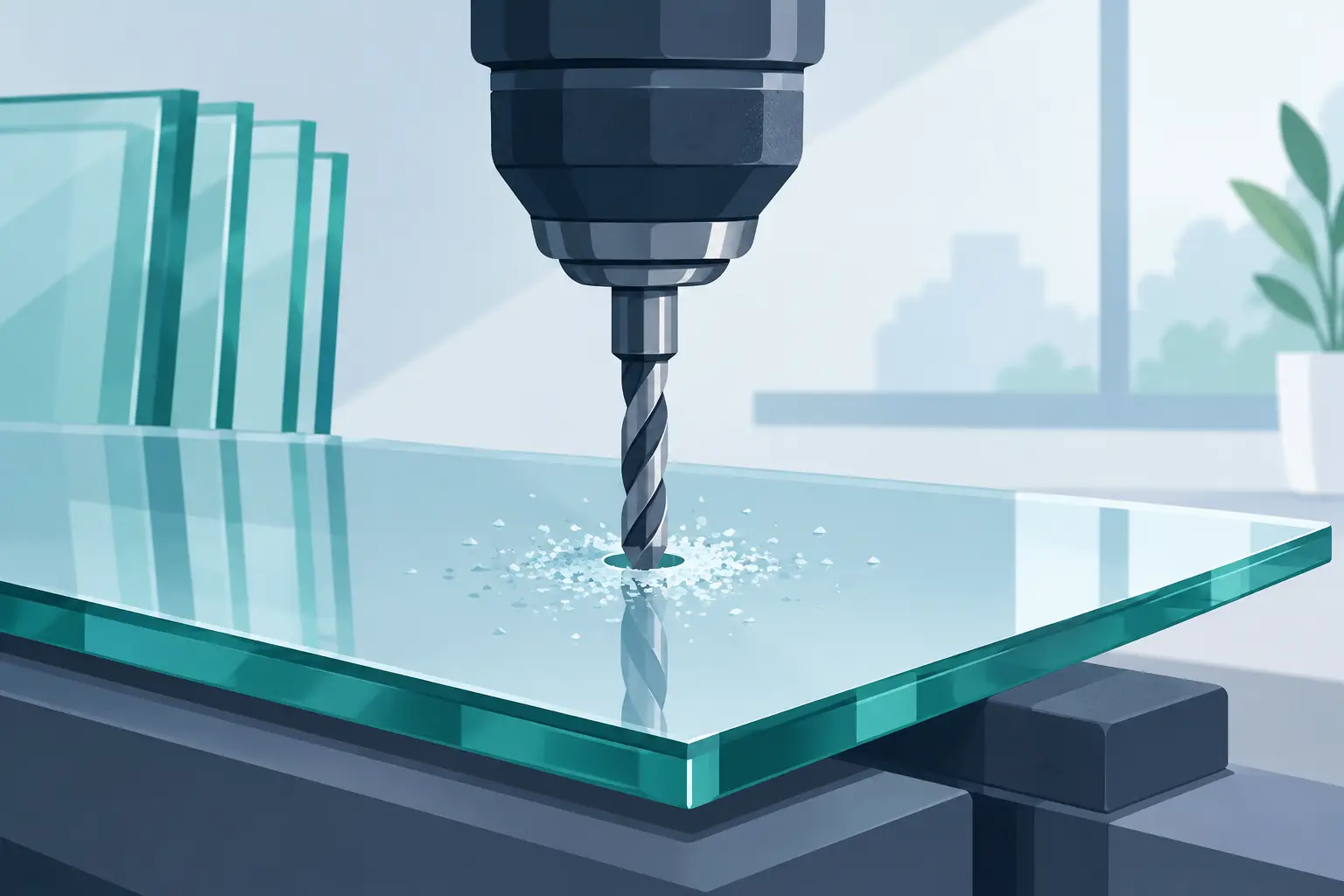
A new shower screen, glass balustrade or kitchen splashback can look simple once fitted, but the details need deciding well before manufacture begins. Drilling toughened glass is one of the most important of those details. If a panel needs holes for hinges, handles, brackets, sockets or fixings, they must be cut before the glass is toughened. Trying to drill a finished toughened panel will cause it to break.
That can be frustrating if a measurement changes late in a project, but it is also why careful planning matters. A correctly specified panel arrives with clean, accurately positioned holes and finished edges, ready for safe installation.
Toughened glass is ordinary float glass that has been heated to a very high temperature and then cooled rapidly. This process places the outer surfaces under compression, making the glass much stronger and safer than standard annealed glass. If it does break, it is designed to crumble into small, comparatively blunt pieces rather than large dangerous shards.
Those internal stresses are also the reason a toughened glass panel cannot be altered afterwards. Drilling, cutting, notching or even grinding an edge disrupts the balance created during toughening. The panel can shatter immediately, sometimes with little warning.
For homeowners, the key message is straightforward: the finished size, shape, edge finish and every hole or cut-out need to be agreed before the glass goes into the toughening process. It is not a job for a drill bit at home, nor a small adjustment an installer can make on site.
The process starts with cutting the glass to its final size while it is still annealed. Specialist machinery uses diamond tooling and water cooling to create holes at the required diameter and position. The water helps control heat and clears away fine glass particles, while the diamond tool cuts gradually rather than forcing its way through the panel.
Once the hole is made, its edges are finished to remove sharpness and reduce the risk of stress points. Any polished edges, shaped corners, notches or cut-outs are completed at this stage too. Only then is the panel toughened.
This order of work means the measurements supplied for production must be reliable. A few millimetres can matter where a hinge needs to line up with a wall channel, or where a socket cut-out has to sit neatly over an existing electrical back box. For a made-to-measure project, a site survey can prevent avoidable surprises.
A hole cannot be placed just anywhere in a glass panel. It needs sufficient clearance from the edge, from other holes and from corners or internal cut-outs. These allowances depend on the glass thickness, panel dimensions, fixing type and what the glass will support.
For example, a hole for a cabinet handle has different demands from a hole for a heavy shower door hinge. A balustrade panel may use carefully engineered fixing points that work with the chosen brackets, glass thickness and loads. The right arrangement is not simply about appearance. It helps distribute pressure safely through the glass.
Very small holes, closely grouped holes and large cut-outs can all be possible in suitable applications, but there are limits. A glass processor will assess whether the design can be made safely and suggest practical adjustments where needed. Moving a hole slightly, increasing its diameter or choosing a different fitting can make a difficult specification workable without spoiling the look.
Drilled holes are common in interior glasswork, although their purpose changes from project to project. Frameless shower screens often need holes for hinges, support bars and handles. Glass doors may require holes and shaped cut-outs for patch fittings, locks and pull handles.
In kitchens, a painted glass splashback may need accurately placed cut-outs for plug sockets, switches and extractor controls. These are generally larger shaped openings rather than round holes, but the same rule applies: every opening must be processed before toughening.
Glass balustrades may be drilled for stand-off fixings or designed around base channels and clamps, depending on the system and the building layout. Mirrors, glass table tops and display panels can also need holes for decorative fixings, cable routes or furniture hardware. Each application calls for the correct glass type and thickness, not just a panel with a hole in it.
The best material depends on where the panel will be used. Toughened safety glass is a popular choice for shower screens, splashbacks, doors and many internal architectural features because of its strength and break pattern. It is often available clear, low-iron, tinted, painted or with a decorative finish.
Laminated glass is made by bonding two or more panes together with an interlayer. If it breaks, the interlayer helps hold the fragments in place. This can be particularly useful for some balustrades, overhead glazing and locations where retaining the glass after breakage is a key requirement.
Standard annealed glass is easier to cut and drill after purchase, but it is not normally the right choice where safety glass is required. It also breaks into larger, sharper pieces. Choosing the glass solely because it seems easier to modify later can create a bigger problem for safety and compliance.
Building regulations, the panel location and the proposed fittings all influence the specification. In bathrooms, near doors, in stair areas and around changes in level, safety requirements deserve proper consideration. If you are unsure, it is better to discuss the application before ordering than try to make a finished panel fit afterwards.
Measure from fixed finished surfaces, not from walls or units that are still likely to move. Tiled walls, plasterboard, floor finishes, cabinetry and shower trays can all affect the final dimensions. In older properties especially, walls are rarely perfectly plumb or square.
For a splashback, record the precise position and size of every socket or switch, checking that the faceplates and their fixing screws will sit properly once installed. For shower glass, allow for the actual hinge, seal and channel system rather than measuring the opening alone. For glass with visible brackets, centre lines are often as important as edge measurements.
It is also worth confirming who is supplying the fittings. Different hinge and bracket systems have different hole sizes, centres and glass thickness requirements. Providing the fitting details early avoids a situation where a beautifully made panel does not match the hardware on installation day.
Yorkshire Glass manufactures bespoke glass in Leeds, so the team can review non-standard sizes, colours, cut-outs and fixing requirements before production. For complex work, clear measurements, photographs and a discussion of the intended installation give everyone a better starting point.
No. A hole cannot be added to a finished toughened glass panel. The same applies to trimming an edge, creating a notch for a pipe or cutting a new socket opening. In most cases, the safe solution is to manufacture a replacement panel to the revised specification.
There are occasional alternatives, but they depend on the design. A surface-mounted fitting may remove the need for a new hole, or an adjustable bracket may accommodate a small change in position. These options should be assessed carefully, particularly where the glass is structural, load-bearing or used as a safety barrier.
Do not rely on suction cups, adhesive hooks or improvised fixings as a substitute for properly specified hardware. They may be suitable for light temporary items, but they are not a safe answer for doors, shelves, rails or anything that will carry weight.
The best glass installations feel effortless because the difficult decisions were made early. Confirm the final dimensions, fittings, hole positions and cut-outs before toughening, and the finished panel can perform exactly as intended. If a detail is unclear, asking for advice before manufacture is always easier than replacing a panel afterwards.