
Leeds Glass Suppliers. Call our team on
Get A Fast Quote
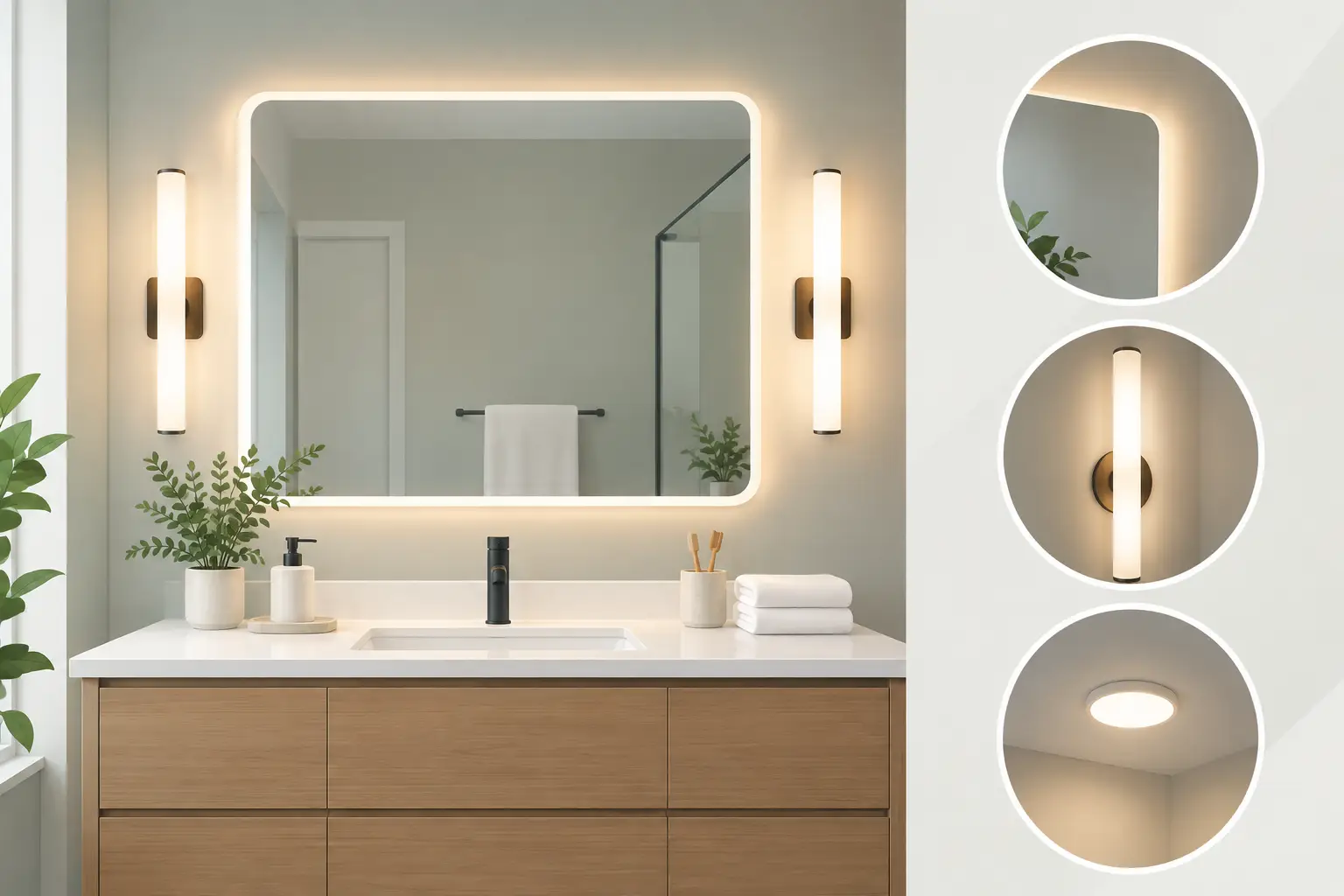
A bathroom can have beautiful tiles, a well-made vanity and a mirror that fits perfectly, yet still feel disappointing when the lighting is wrong. This bathroom mirror lighting guide focuses on the area where good light matters most: your face. Get it right and shaving, skincare, make-up and getting ready are easier, while the whole room feels more considered.
Mirror lighting has a different job from general bathroom lighting. Ceiling spots may light the room adequately, but they often cast shadows under the eyes, nose and chin. That is unhelpful when you are applying make-up, shaving or simply checking your appearance before leaving the house.
The most flattering arrangement places light at or close to face level, from both sides of the mirror. This gives a more even spread across the face than a single fitting directly above it. A light above the mirror can still work well as part of the scheme, particularly over a wide double basin, but it should not be the only source if accurate task lighting is the aim.
For most family bathrooms, aim for lighting that is bright enough to be useful without feeling clinical. The right level depends on the room’s size, wall colours, natural daylight and the finish of your surfaces. Dark tiles and antique mirror finishes absorb more light than pale gloss surfaces, so they may need a little more output.
The colour temperature of a lamp is measured in Kelvin. It has a major effect on how the bathroom feels and how skin tones appear in the mirror.
Warm white light, around 2700K to 3000K, has a softer, more relaxed character. It suits bathrooms designed as calm evening spaces, especially where there are warm-toned tiles, brass fittings or timber furniture. However, very warm light can make colours look slightly yellow, which is not always ideal for grooming.
Neutral white, generally around 3500K to 4000K, is often the best all-round choice for mirror lighting. It is clean and practical without the blue cast associated with very cool lamps. It works particularly well in bathrooms used for make-up, shaving and morning routines.
Look at the Colour Rendering Index, or CRI, as well as the Kelvin rating. A CRI of 90 or above will show skin, towels, paint and make-up colours more faithfully. Lower-quality LEDs may be bright but still make the reflection look flat or unnatural. For a mirror used every day, colour accuracy is worth paying attention to.
The layout should follow the mirror size, basin position and who will use the room. There is no single fitting that suits every bathroom.
Vertical lights on either side of the mirror are usually the strongest option for task lighting. Position them roughly at face height, with the centre of each fitting commonly around 1500mm to 1700mm from the finished floor. The exact height should be adjusted for the household, especially in a bathroom used by very tall adults or younger children.
For a single basin, two slim wall lights can frame a rectangular mirror neatly. In a wider space with two basins, you might use a pair of lights around each mirror, or use one long mirror with several evenly spaced fittings. The key is to avoid bright patches and deep shadows.
A horizontal light above the mirror can give a tidy, contemporary look. Choose a fitting that is broadly similar in width to the mirror or vanity, rather than a small light centred over a wide piece of glass. A narrow fitting can leave the outer parts of the face in shadow and make the installation look undersized.
This arrangement is particularly useful where there is limited wall space at the sides, such as a compact cloakroom or a mirror fitted between tall cabinets. Pair it with good ambient ceiling lighting, and consider a backlit mirror if you want softer background illumination as well.
An illuminated mirror with LED lighting behind the glass produces a soft halo on the wall. It can make a smaller bathroom feel more spacious and provides a gentle light level for night-time use. It is a popular choice for contemporary schemes because there are fewer visible fittings and the mirror remains visually clean.
The trade-off is that backlighting alone may not give enough direct light for detailed grooming. Some illuminated mirrors combine front-facing LEDs with a backlit edge, which gives a better balance of function and atmosphere. If you prefer a plain made-to-measure mirror, wall lights can offer more flexibility over style, position and future replacement.
Lighting should be planned before the mirror is ordered, not treated as a last-minute addition. The mirror may need to be narrower to leave room for side fittings, or wider to sit comfortably beneath a horizontal light. This is especially relevant with bespoke mirrors, shaped edges, tinted finishes and mirrored cabinets.
As a general rule, a mirror should relate to the basin or vanity below it. It may be the same width, slightly narrower, or extend wider where the room calls for a more generous look. A full-width mirror can be effective above a double vanity, but make sure the lights do not interrupt useful reflection space.
Think about practical clearances too. Wall-mounted taps, tall mixers, cabinets, splashback tiles and extractor controls can all affect where a mirror sits. Measure from finished surfaces, rather than from an early plan, and allow for tile thickness and fitting projections. A few millimetres can matter when glass is made to a precise size.
Bright light is not automatically good light. An exposed bulb that shines directly into the eyes can be uncomfortable, particularly in a small bathroom where reflective tiles and glass intensify the effect. Frosted diffusers, opal shades and well-designed LED profiles soften the source while keeping the light useful.
Glare can also come from the mirror itself. If downlights are positioned too close to the wall, their reflections may be visible as harsh bright spots. Before finalising a lighting plan, stand where you will use the basin and consider what will appear in the mirror at eye level.
Dimming is a worthwhile option where possible. A brighter setting is useful in the morning or for detailed tasks, while a lower level makes a late-night bathroom visit less jarring. Check that the light fittings, LED drivers and dimmer switch are compatible. Not every LED product dims well, and incompatible components can lead to flickering or a restricted dimming range.
Bathrooms have specific electrical requirements because water and electricity need careful separation. Light fittings must have a suitable IP rating for their location, and the zones around a bath, shower and basin affect what can be installed. The closer a fitting is to a water source, the more protection it usually needs.
Your electrician should confirm the appropriate fittings and wiring arrangement before anything is fixed in place. This is particularly important for illuminated mirrors, demister pads, shaver sockets and wall lights mounted close to a basin. It is far easier to position cables correctly before tiling and before a mirror is installed.
A demister pad is a useful addition if the bathroom gets steamy. It gently warms part of the glass so a clear section remains available after a shower. It does not replace ventilation, but it can make a mirror much more convenient in a busy household.
The lighting fittings and mirror do not need to match exactly, but they should look intentional together. Black fittings can give a crisp frame to a clear mirror in a modern bathroom. Brushed brass brings warmth to neutral stone-effect tiles. Chrome remains a practical choice where taps, shower fittings and accessories already use the same finish.
The mirror itself can do more than provide a reflection. A polished edge suits clean contemporary schemes, while a bevelled edge adds definition without becoming ornate. Bronze, grey or antique mirror finishes can soften the look of a larger wall of glass, though they will naturally reduce reflection brightness compared with clear mirror.
At Yorkshire Glass, made-to-measure mirrors can be planned around existing lights, awkward walls and individual vanity sizes, rather than forcing the room to suit a standard stock size. Bringing measurements, photos and a note of your planned light fittings makes the decision much easier.
Before ordering, mark the mirror and fitting positions on the wall with low-tack tape. It is a simple way to check proportions, reach and sightlines while there is still time to adjust the plan. The best mirror lighting feels natural when you use it - bright where it needs to be, gentle when it does not, and properly suited to the bathroom you have created.