
Leeds Glass Suppliers. Call our team on
Get A Fast Quote
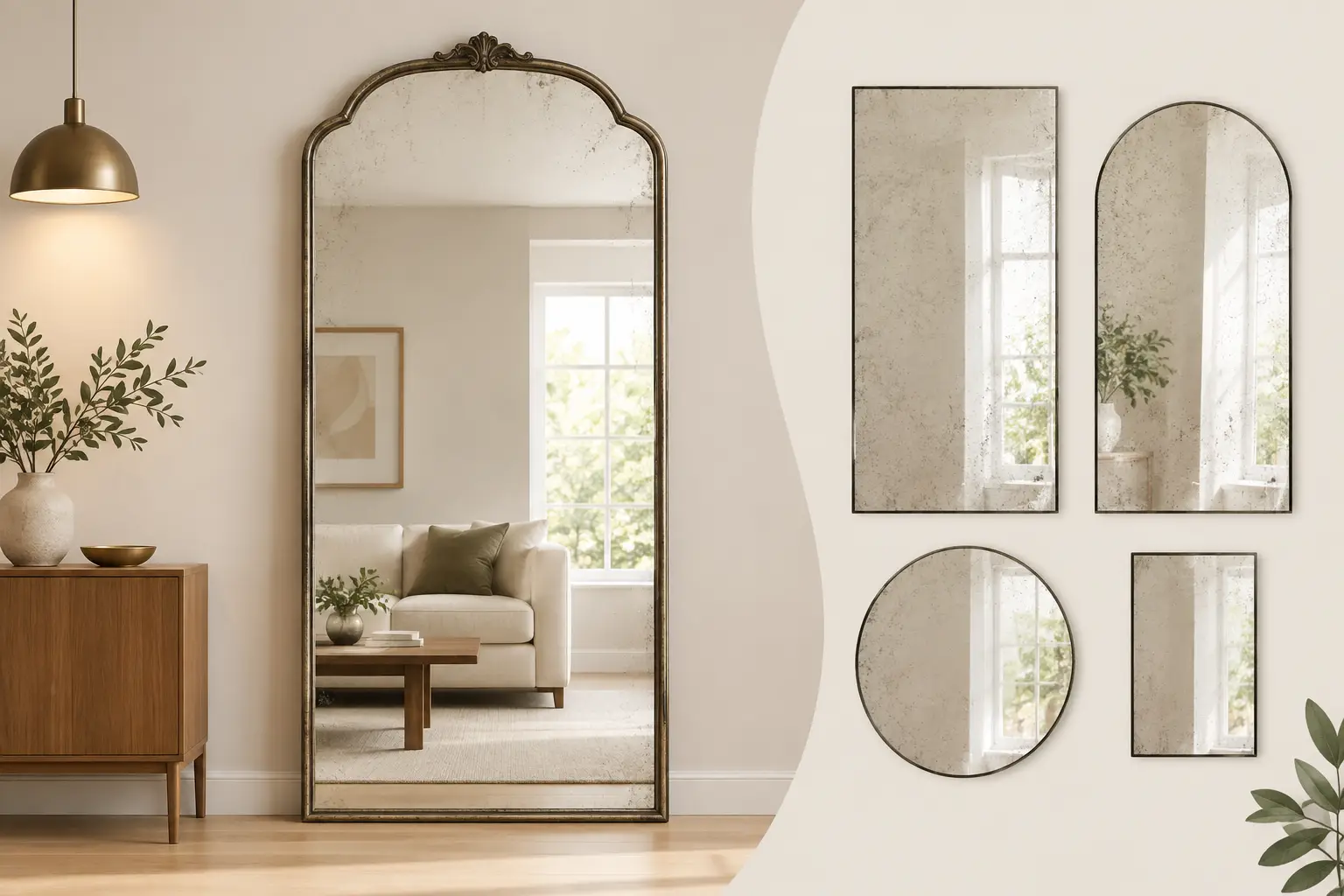
A beautifully aged mirror should not be forced to fit a standard sheet size. An antique mirror cut to size gives you the character of foxed, mottled glass with proportions that properly suit your wall, cabinetry or furniture. The result can feel original to the room rather than like an afterthought.
Antique mirror is popular because it has more depth than a clear, modern mirror. Its aged markings catch the light softly, break up reflections and bring warmth to schemes that might otherwise feel too new or too polished. The important part is getting the size, finish and installation details right before the glass is made.
Made-to-measure mirror allows the glass to work around the features already in your home. It can be produced for a chimney breast, an alcove, fitted wardrobe doors, a bathroom wall, a bar area or a run of kitchen units. You are not limited to the dimensions or edge finish of an off-the-shelf mirror.
That flexibility matters in Yorkshire homes, where walls are not always square and period properties often have awkward reveals, fireplaces and uneven surfaces. A precise survey can account for these details, leaving the correct expansion gaps and allowing for sockets, switches, cupboards or pipework where needed.
There is also a design benefit. A narrow panel above a sideboard may need a different antique finish from a large wall mirror in a dining room. With a bespoke order, the glass can be proportioned to the room and paired with a polished edge, a bevelled edge or a framed detail, depending on the look you want to achieve.
The term antique mirror covers a broad range of appearances. Some finishes have delicate speckling around the edges, while others have stronger dark patches, clouding or a more pronounced distressed pattern across the surface. No two panels will look exactly alike, and that variation is part of the appeal.
For a calmer, contemporary room, a lightly aged finish usually gives enough texture without making the wall feel busy. In a traditional dining room, a darker or more heavily foxed mirror can add character and sit comfortably alongside timber, brass and painted joinery. If the mirror will cover a large area, ask to see a sample first. A pattern that looks subtle on a small swatch can appear much bolder across several square metres.
Think about what the mirror will reflect, too. Antique mirror is less clear than standard mirror, but it still bounces light and movement around the room. It works particularly well opposite a window, beside a dining table or behind shelving, where the reflection adds depth without acting like a perfect looking glass.
A made-to-measure antique mirror is a decorative material, not a printed tile with an identical repeat. The ageing, colour tones and markings will vary from panel to panel and sometimes within one sheet. Where several pieces meet, a specialist can discuss the best way to position and align them, but an invisible continuous pattern cannot always be guaranteed.
This is one of the few occasions where a little irregularity is exactly what gives the finished job its character.
Antique mirror can make a strong feature without taking over a room. In living rooms, it is often used above a fireplace, within alcoves or as a full-height panel behind a console table. In bedrooms, it can bring softness to wardrobe doors or a dressing area, especially when combined with warm lighting and textured finishes.
Kitchens are another popular choice. An antique mirror panel behind shelving, along a breakfast bar or between cabinetry can give a kitchen a more individual feel than plain glass or tile. Its mottled finish is forgiving of light marks and reflections, while still helping a smaller kitchen feel more open.
Bathrooms need more consideration. Mirror glass in a bathroom must cope with moisture, ventilation and the fixing method. Edges and cut-outs need careful planning, particularly around basins, taps and illuminated cabinets. A well-ventilated room and properly specified adhesive will help protect the mirror backing over time.
For any location close to heat, water or regular impact, suitability depends on the exact product and installation. A decorative antique mirror is not automatically the right choice for every splashback, shower area or commercial setting. Discuss the intended use before ordering so the glass specification is chosen for the job, rather than simply for its appearance.
Accurate measurements are what separate a neat fitted panel from one that is difficult to install. Do not assume a wall, recess or cupboard run is perfectly square. Measure the width at the top, middle and bottom, then measure the height on both sides. The smallest dimensions are usually the safest starting point for a panel fitting into a recess.
Before requesting a quote, it helps to have four details ready:
Allowing a small fitting gap is normally sensible, especially around walls, units and joinery that may not be perfectly straight. The right allowance depends on how the panel will be fixed and whether it is framed, edge-to-edge with another panel, or set into a channel. This is where site measuring can save time, wasted material and last-minute compromises.
Sockets, switches and pipe outlets should be marked from fixed reference points, such as the left-hand edge and the bottom of the glass. Include the overall dimensions of the fitting, not just the visible faceplate. If a socket is likely to be moved during a renovation, finalise that work before the mirror is measured.
Once glass has been cut, it cannot be trimmed down on site in the way timber can. Taking a little extra care at this stage is worthwhile.
For exposed edges, a polished finish is usually the practical choice. It creates a clean, smooth edge that feels finished and is easier to clean. A bevelled edge can add a more formal decorative detail, although it changes the visible border and needs to be allowed for when setting out multiple panels.
The appropriate thickness depends on the panel size, location and fixing method. Larger mirrors may require additional support or mechanical fixings, while a small framed piece has different requirements. Heavy glass should never be treated as a simple DIY hanging job without considering the condition of the wall and the load it will carry.
Mirror adhesive must be suitable for mirror backing. Some general-purpose adhesives can damage the coating over time, causing black spots or deterioration that may not appear until months after fitting. Neutral-cure products and the correct preparation of the wall make a real difference. Mechanical fixings can be useful in certain applications, but they need to be planned before manufacture because drilled holes and notches are made in the workshop.
Antique mirror should be cleaned gently. Use a soft cloth and a small amount of glass cleaner applied to the cloth, rather than spraying heavily onto the mirror edges. Avoid abrasive pads, harsh chemicals and prolonged moisture around the perimeter. In kitchens, wipe splashes away promptly, particularly near joins and cut-outs.
Good installation is just as important as careful cleaning. The wall should be dry, sound and reasonably flat, with adequate support while the adhesive cures. If the panel is part of a larger fitted scheme, fitters should also consider access routes, lifting and how the glass will be protected while other trades are still working nearby.
At Yorkshire Glass, antique mirrors are made to individual requirements in our Leeds workshop, so unusual sizes, shaped panels and carefully positioned cut-outs can be discussed before production. Bringing measurements, photographs and a few details about the room gives the team a clear starting point.
The best antique mirror installations do not look overly designed. They simply make a room feel brighter, deeper and more settled. Choose a finish you genuinely like, measure with care and let the glass be made for the space it is going into.